

I am not a theater critic but I have been devoted to covering theater since my early 1980s reports on the explosion of Chicago storefront theaters for National Public Radio. On The Mara Tapp Show in the 1990s, I was honored to host weekly conversations about and offer scenes from some of Chicago’s best shows, and delighted when those interviews filled houses for our local theaters.
In 2015, at the request of friends, I started a series of emails with recommendations for shows I thought worthy of patrons. Some years later, actors, directors and publicity people in Chicago’s theater world prevailed on me to share these raves, a request I accepted, especially in light of the increasing tensions in the theater world and need to keep Chicago theaters healthy. Read more…
Find out what the critics think at the Review Round-up on the website of TheatreInChicago.com.
Breaking News
Theater Raves has been renamed Raves to reflect the fact that I am now also raving about music performances and art exhibitions. Here’s to raves about all the arts!
I’ve stepped into the 21st Century and you can find my raves on Instagram at https://www.instagram.com/tappraves/. Please follow me to shine a spotlight on the excellent performing arts organizations and artists I am honored to cover.
Theater Raves
Leopoldstadt
Writers Theatre through August 9
Highly Recommended
When the lights come up on Tom Stoppard’s last play, one can’t help but be pulled into the warm embrace of an extended family of accomplished Jews and Christians, and the tumble of their joyous life. They are happy, bursting with ideas, memories and good humor, and at peace with themselves. The children are decorating a Christmas tree in this elegant Viennese apartment while the adults gather in small groups to muse on intellectual matters, gossip and fulminate about politics before enjoying chocolate cake with whipped cream.
Leopoldstadt is Stoppard’s most personal play, inspired by autobiographical details of his life in Czechoslovakia and England, yet it is hallmark Stoppard. It brims with the ideas and issues that animated his work, from the existentialism of Rosenkrantz and Guildenstern are Dead to the rich mix of art, memory and politics in Travesties to the love in The Real Thing to the mathematics, philosophy and physics so essential to Arcadia to the wit and romance of Shakespeare in Love. What’s different here is the scale. Originally performed in larger theaters, Stoppard and Carey Perloff, his frequent collaborator, reworked it for Writers Theatre’s more intimate space.
Everything about Leopoldstadt is epic, from the size of the cast of 25 to the scope of the historical moments covered to the range of ideas explored. This is a play about history – the history of this family but also the way its members enjoy, endure and survive their times. Stoppard doesn’t stop with this microcosm. He forces his audience to experience world history. Some of these facts will be familiar to those who know history; others will be shocking. What makes this play work is that Stoppard, its director and cast illuminate critical events in the 20th century through the actors’ visceral portrayals.
The play follows the 26-member family through four critical periods in Austrian and Jewish life. We meet the Merzes in 1899 in the home of Emilia, her son Hermann, who now runs the successful family business, his wife and their son. The extended family members are firmly ensconced in Vienna, replete with its art, music and rich intellectual life. Jews are very much a part of this. In fact, Jewish authors – Sigmund Freud, Playwright Arthur Schnitzler and Zionist Theodor Herzl – are being debated in the opening scene. Then it is 1924 and the Merzes have gathered for a circumcision ceremony. Their luxurious apartment retains its elegance but the scars of World War I are clear. By 1938, the family has been hurt by the rise of the Nazi party, particularly virulent in Austria. They inhabit a home without heat and with considerably fewer treasures. Leopoldstadt ends in 1955 in the much-changed Merz apartment as the surviving members gather. The devastation of World War II is unavoidable.
Leopoldstadt is also a Jewish play even though it wrestles with larger issues of identity and persecution. What nags here is the question of why Jews, even when they put nationalism in front of their religion and culture, are rarely seen by others as belonging to that country. Ever the wordsmith, Stoppard finds the perfect way to sum this up.
“My grandfather wore a caftan. My father wore a top hat to the opera and I have the singers to dinner,” Hermann tells his brother-in-law. “We literally worship culture. When we make money, that’s what the money is for, to put us at the beating heart of Viennese culture. This is the Promised Land, and not because it’s some place on a map where my ancestors came from. We’re Austrians now. Austrians of Jewish descent! … We’re the torchbearers of assimilation.”
That perceived assimilation did not save this family nor the Jews of Vienna. By 1890, Viennese Jews were close to 100,000, just over 12 percent of the population. In 1934, they had dropped to nine percent of the population but numbered over 175,000. By 1951, there were 9,000 in Vienna, barely a half percent of its population.
Carey Perloff directs Leopoldstadt with impressive skill, bringing out the collective and individual strengths of this uniformly excellent cast, a who’s who of some of Chicago’s greatest theater stars. The actors who play children are especially strong in very difficult roles. A few of the adults must be singled out for praise. Barbara Robertson plays the matriarch with elegant grace and humor, alternately coddling and teasing her grandchildren. “Poor boy, baptised and circumcised in the same week, what can you expect?” she quips to the mother of her grandson when he confuses the Star of David with the Star of Bethlehem. Ian Barford as Hermann Merz is stronger than he’s ever been. His expressions of tenderness for his wife – like the powerful moment when he wraps her in her green shawl for a sitting for the portrait he’s commissioned from Artist Gustav Klimt to demonstrate his spousal love –his family leadership and arguments about the politics of the day show expert range and deepen his character. Kate Fry as his beloved wife is a delight, making the reason for his devotion clear with her sweet gentle nature and her absolute comfort as one of the non-Jewish members of the family. Sean Fortunato, the other non-Jew, is equally at home, and demonstrates a similar devotion to his wife plus the compassion of a doctor to his relatives. Sarah Coakley Price summons her serious side as his loving wife and an amiable representative of the less elite clan joined to the Merzes by marriage. Erik Hellman, skillful in a double role as most cast members are, brings very different but equally persuasive passion to his portrayal of a gentleman officer in an affair and, later, a British journalist prescient about what will happen to Viennese Jews under Hitler.
The production team makes Leopoldtstadt a dream worthy of the 18th-Century Biedermeier era in German-speaking Europe, which drew the middle classes into the worlds of art and culture. Ken MacDonald’s set, with its flourishes from wallpaper to objects d’art, envelopes the actors and audience. The glorious period costumes by Alex Jaeger, along with Tom Watson’s makeup and wigs, bring the 1890s to life. Keith Parham’s lighting design warms the Merz apartment in happy times and plunges it into grey or stark unforgiving white in times of horror.
Everything in Leopoldstadt is so intentional and enhances the viewing experience, noted the Brilliant Redhead, my companion, from the lovely waltzes to the realities of the Nazis’ rise. Stoppard’s continuing battle against fascism is unavoidable in the play’s later decades. It was nearly impossible not to recognize the connection between the sounds and signs of political terror from Kristallnacht and Nazi interrogations to January 6 and ICE actions. Yes, this play, like so many of Stoppard’s, has universal messages and yet it remains a Jewish play at heart.
“Antisemitism is a political fact,” one of the Austrian greatgrandchildren tells another in 1955. “It will never happen again,” his British cousin reassures him. The Austrian’s sarcastic response speaks simple truth – “I bow to your experience.”
At the end of this journey across generations and centuries, the Merz matriarch and one of her progeny should have the final say. When unable to identify a couple in a photo album, Emilia says, “It’s like a second death, to lose your name in a family album.” As the play closes, the momentous value of history, both personal and political, is inescapable. A greatgrandchild chastises his cousin for living “as if without history, as if you throw no shadow behind you.” Consider Leopoldstadt Stoppard’s shadow and do whatever you can to stand in its wisdom.
An Enemy of the People
TimeLine Theatre Company through June 27
Highly Recommended
How fitting that TimeLine Theatre Company’s debut in its dazzling new home is timeless. The company is known for its unflinching examinations of history so it makes sense that it would choose Norwegian Playwright Heinrik Ibsen’s attack on cowardice and corporate greed.
His 1882 play has been adapted many times, perhaps most notably in the 1950s by American Playwright Arthur Miller as a cautionary tale about the “Red Scare” then sweeping America. Playwright Amy Herzog’s version keeps An Enemy of the People in its era but streamlines it by removing several characters, updating the dialog and offering a more sympathetic whistleblower. She also finds the humor in the play, lifting it from what could be a deadly didactic. The result is a modernization that maintains the integrity of the original with its critical themes of courage, the evil of unfettered business ventures, the chilling effect of the profit motive when aligned with power and the long-term effects of medical and environmental dangers. Timeless.
Dr. Thomas Stockmann, a respected doctor who has just started as the medical director of a new spa that will bring the healing virtues of his small Norwegian town’s waters to many and benefit the coffers of the town and spa owners. His discovery of toxic impurities in the water puts him in conflict with his brother, the mayor, and eventually with much of the town.
Ron OJ Parson, one of Chicago’s top directors, guides a splendid cast with his usual skill, allowing each actor to shine in his or her moment and bringing out the humor in the script. Will Allan persuasively plays Dr. Stockmann as a man whose principles are honorable but can easily veer into righteousness. When the doctor’s singlemindedness blinds him to the subtleties of the interaction between the power of commerce and public opinion, this play could be retitled “His Own Worst Enemy,” and yet Dr. Stockmann’s stand is admirable and correct. A particularly moving moment comes when he aptly summons up Charles Darwin, father of the theory of evolution, with all passion due a fellow scientist. Campbell Krausen is his steadfast daughter Petra. Krausen brings an impressive flexibility and grace to the role. Nimbly moving from expressing unflagging devotion to her father and his salvation mission – she is a teacher and has no trouble grasping the science of what’s at stake here – to a wit and snappiness that show her intelligence and are amusing when she greets the procession of what seems to be every young man’s yearning for her. She is the purest person in this play, it moral voice. Behzad Dabu has the toughest role as the mayor, a man devoid of morals or likeable qualities, but he does an admirable job portraying this villain with all the ticks of a vengeful man.
The townspeople are equally impressive and more than a few stand out. Charles Andrew Gardner’s portrayal of Captain Horster as a man of deep compassion is elevated by his ability to convey the gentle loyalty of a true friend. Anish Jethmalani, an accomplished TimeLine veteran, is publisher of the town’s newspaper. He ideally embodies a man transformed by the realities of the business. Another respected TimeLine company member, David Parkes, exhibits unaltered evil, relishing every moment as Dr. Stockmann’s scheming father-in-law. Grayson Kennedy plays the town’s newspaper editor, adeptly moving from a man thrilled by a hot story to one whose naivete is checked when he understands how it could affect his future.
Production values are critical in this show. John Culbert’s fine wooden set offers spaces that accommodate dinners around the Stockmann table, essential moments in the doctor’s office, town meetings and newspaper offices. Christine Pascual’s costumes garb each character in clothing appropriate to their station and personality. Brandon Wardell’s lighting design is especially illuminating for its moments of sunlight, which seem to summon the Enlightenment as they portray the purity of the human heart and hope.
It would be too easy to place An Enemy of the People in our times when big businesses interests and the obscenely wealthy are eclipsing everything but that’s not just what’s happening here. This is also the story of the choices of small cogs in the machine. It is a warning about the momentum of mob mentality, about the essential need for science, about the dangers of impeding an independent press. Almost everyone here is complicit and compromised either by ethics or lack thereof. The Brilliant Redhead, who accompanied me, saw Enemy of the People as a Marxist fable with its weaponization of formal procedures and rules rendering principles nonexistent.
As is the case with so many of TimeLine’s best works, it is impossible not to draw a connection to the present. That, after all, is what history affords us if we allow it to show us the mistakes of the past. Seize the opportunity to experience this old-fashioned, updated morality tale.
Job
Writers Theatre through August 2
Highly Recommended
It starts with a gun. Actually, Job, an arresting, shocking play, has multiple beginnings, which is a fine foreshadowing of the many surprises to come.
This is a challenging piece to let alone write about, let alone wrap your head around – perhaps apt for a play about a therapy session – because of those surprises, which would be ruined should they be revealed. Call this a high-order head game with soaring stakes.
Jane works for a major tech company. A video of her breakdown went viral so she is now on leave. The only way Jane can return to the job that consumes her life is with a sign-off from a crisis therapist. This brings her to Loyd, a therapist quite a bit older than she is, and an epic battle on multiple levels begins. What is constant in this taut show is tension.
Rae Gray brings her considerable skill at portraying alienated, troubled people to Jane with an almost a surgical precision. She presents as deeply troubled woman. Gray’s portrayal of a millennial whose breadth of knowledge and emotion breaks the stereotypes about her generation is smart and insightful. She is the kind of person who is too bright to do well on multiple-choice tests because she can see how each of the answers is possible. Christopher Donahue is the psychologist to whom she comes. A boomer who seems California laid-back, fitting since the play is set in San Francisco, Donahue is adept at expressing calm, passivity and fear in what becomes a contest of power and control.
Max Wolf Friedlich’s play addresses much in under 90 minutes. It tackles the tech world, takes on the ugliest sides of the evil, evil web, lays bare generational and gender divides and obstacles and examines the patient-therapist relationship in a time in which therapy is so prevalent and psychobabble seems dangerously close to becoming a common dialect. David Esbjornson’s stark and precise direction keeps this intimate and disturbing show focused.
That disturbing intimacy extends to the audience, which is brought fully into the action by Jack Magaw’s set that occupies the middle of the smaller theater at Writers. Willow James’ and Christopher Kriz’ chilling sound design punctuates the show with alarming utterances and sounds, dramatically lit by James F. Ingalls. All add to the unease heavy in the room.
Job is a psychological drama in every sense, a show that draws you in and forces examination of the many issues it presents before its shocking ending. See it for the acting and what it tells us about ourselves and our times.
Musical Homage


Remembering Tom Lehrer
I was about 11 when Tom Lehrer jumped into my consciousness and stole my intellectual heart.
I’ll blame it on my parents who were crazy about this genius mathematician-turned-showman, the author of some of the wittiest satirical songs most of us had ever encountered. We spent many a night after family dinner wearing out the vinyl on Lehrer’s That Was the Year that Was. By the time I was12 I knew all the lyrics on that album, and a couple other well-worn records by Tom Lehrer. For true Lehrer devotees, picking a favorite song is impossible but singing as many as possible as often as possible is impossible to resist – much to the annoyance of non-Lehrer fans or other sorts of American Puritans he would most certainly eschew. Fortunately, my parents were far from that, and I had the good luck to marry a man who happily sang Lehrer along with me, though he was usually in key. So Lehrer’s late July death at 97 hit me with enough of a smack that it’s taken me a while to collect my thoughts, and to trace his impact on my life.
In my junior year of high school, my mother was offered a visiting professorship at Harvard Law School, an opportunity she happily accepted for many reasons, not least among them that she’d not been able to accept the full scholarship Radcliffe offered her because her parents couldn’t afford to send her across the country for college. Already a surly teenager, I was eager to escape the irritating pretensions of the University of Chicago, where the administration often made racist and other horrible decisions that eclipsed the good work and politics of my parents and their friends and colleagues. My parents took the view that while the Hyde Park neighborhood had some merits and lots of smart and wonderful people, it also possessed a cloyingly small-town nature that required true city folks like us to leave it often to explore the delights of Chicago, and to find decent restaurants. Given this, my adolescent spirit was prepared to dive into in the cosmopolitan charms of Cambridge and Boston. That disappeared as soon as I discovered that pretense and academic pedigrees were an art form at Harvard compared to the rumpled, multisyllabic, grumpy nature of your average U of C habitué or Hyde Parker.
The fact that I was sent to a “school for young ladies” in a Cambridge house did not improve my teenage outlook. However, one fact, and that school’s proximity to it, elated me. Tom Lehrer taught at Harvard and lived nearby. Call me naïve but, at 15, I thought the best way to meet him was to go to his house every day after school and sit on his steps in the hopes that he would emerge or come home after work whereupon I would express my admiration of his brilliant lyrics and fawn all over him. Weeks went by. This did not happen. Finally, one cold afternoon, the door opened and my heart leapt. A woman peered out and asked me why I was sitting on her porch every day. I explained that I wanted to meet Lehrer and asked if this wasn’t his house. Yes, she replied, but he had the good sense to go to Santa Cruz that winter and she was renting his house. Crestfallen, I went home and consoled myself with art. At that time, I intended to be a dancer and choreographer so I persuaded one of my two school friends, both also outliers, to join me in creating a dance to Lehrer’s “The Vatican Rag.” Her Czech mother sewed our nuns’ habits from old pillowcases, and we used Mardi Gras beads that doubled as belts we could swing around and as rosaries.
We started performing our “Vatican Rag” around Cambridge. People seemed to like it, except for one woman who found it scandalous and turned to express her view to my father, who was sitting next to her. “That’s my daughter,” he said with some pride. He was a professor of humanities and religious studies among other subjects so I like to think that it was more than mere paternal pride.
The Cambridge grapevine, it turns out, was as good as the Hyde Park one. When Lehrer returned to Cambridge in the spring, word reached him that two girls were performing a dance to his “Vatican Rag” around town. Connections were made, and Lehrer came over to our house, singing and playing the piano while I performed our dance for him. His delight was contagious but not nearly as enormous as mine. My mother, herself delighted, filmed this encounter. Alas that ancient videocassette returned with me to Chicago only to become the one piece of my luggage the airlines have lost forever so all I have is the memory of that remarkable afternoon – and, of course, Lehrer’s glorious song.
I headed off to Macalester College in St. Paul, Minnesota in the Fall but was so smitten with Lehrer that I managed to stay in touch with him. He was campaigning for George McGovern by singing at fundraisers, and the Twin Cities were on his tour. I got to spend an intoxicating evening following Lehrer around and watching him work his magic on crowds. By then, he’d performed on Sesame Street, singing adorable little ditties about “silent e” and its alphabetical relatives. He tickled the Twin Cities audiences by sharing the “Adult X-rated” version of “Silent E.”
As I’ve revisited his repertoire since his death, I’ve been struck by the giddy joys Lehrer’s lyrics cause in songs like “New Math” and “The Elements,” and the relevance of his lyrics in so many songs from “Pollution” to “Who’s Next?” Consider these from “National Brotherhood Week:”
Oh the white folks hate the Black folks
And the Black folks hate the white folks
To hate all but the right folks is an old established rule
But during National Brotherhood Week
National Brotherhood Week …
It’s fun to eulogize the people you despise
As long as you don’t let them in your school
Oh the poor folks hate the rich folks
And the rich folks hate the poor folks…
Oh the Protestants hate the Catholics
And the Catholics hate the Protestants
And the Hindus hate the Muslims
And everybody hates the Jews
But during National Brotherhood Week
National Brotherhood Week
National Everyone-Smile-at-One-Another-hood Week
Be nice to people who are inferior to you
It’s only for a week so have no fear
Be grateful that it doesn’t last all year
I was moved to discover in the many odes to and obituaries to Lehrer that he decided to release the rights to all his songs, telling his fans, “So help yourselves, and don’t send me any money.” He even had a website created for people to download his songs.
No doubt that only expanded Lehrer’s following, as does his songs’ infectious singability, which has made me continue to sing Lehrer’s songs across so many decades whenever and wherever the spirit moves me, which is often. Our children grew up on Lehrer’s songs as well, and I am now introducing my grandbaby to his oeuvre. I’m sure she’ll enjoy the kiddie versions of his Sesame Street songs when she learns to read but, for now, we’re working our way through the age-appropriate highlights of his adult repertoire so she can decide what her favorite will be.
And now for something completely different…
Now this is funny! Duane Cerny is always worth reading but this month’s column is particularly relevant to any who attends any live performances. Full disclosure: Duane has edited many of my raves.

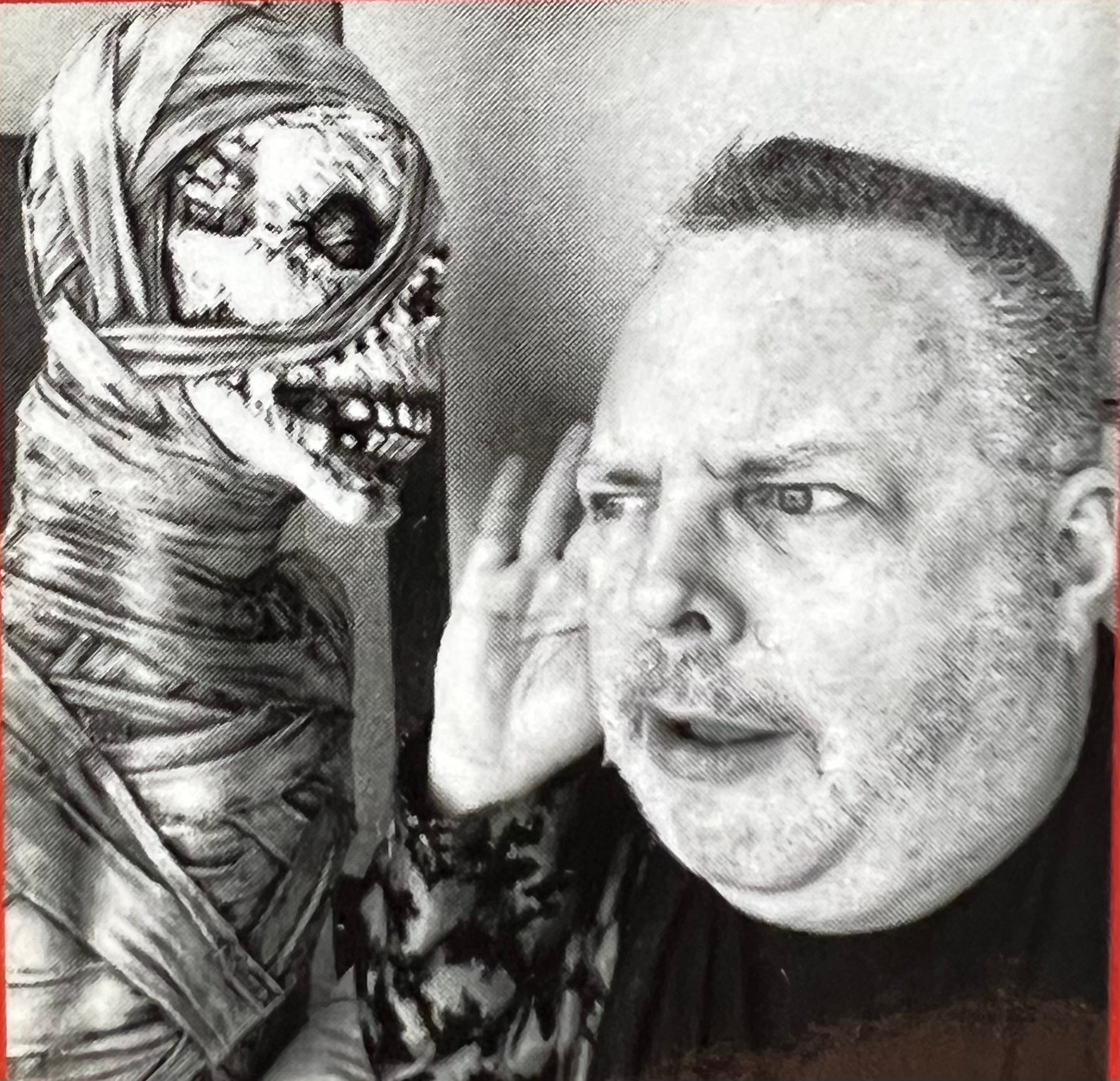
Duane Scott Cerny
It’s All My Fault… Subscribe