

I am not a theater critic but I have been devoted to covering theater since my early 1980s report on the explosion of Chicago storefront theaters for National Public Radio. On The Mara Tapp Show in the 1990s, I was honored to host weekly conversations about and offer scenes from some of Chicago’s best shows, and delighted when those interviews filled houses for our local theaters.
In 2015, at the request of friends, I started a series of emails with recommendations for shows I thought worthy of patrons. Some years later, actors, directors and publicity people in Chicago’s theater world prevailed on me to share these raves, a request I accepted, especially in light of the increasing tensions in the theater world and need to keep Chicago theaters healthy.
Read more…
Find out what the critics think at the Review Round-up on the website of TheatreInChicago.com.
Breaking News
A magnificent shows that I raved about is back! Kokandy Productions’ Jekyll & Hyde, which was honored with multiple Jeff Awards, is now playing at Broadway in Chicago. My original rave is below. If you didn’t catch this show the first time around, make sure you do this time.
Theater Raves has been renamed Raves to reflect the fact that I am now also raving about music performances and art exhibitions. Here’s to raves about all the arts!
I’ve stepped into the 21st Century and you can find my raves on Instagram at https://www.instagram.com/tappraves/. Please follow me to shine a spotlight on the excellent performing arts organizations and artists I am honored to cover.
Theater Raves
Heroes of the Fourth Turning
A Red Orchid Theatre through December 6
Highly Recommended
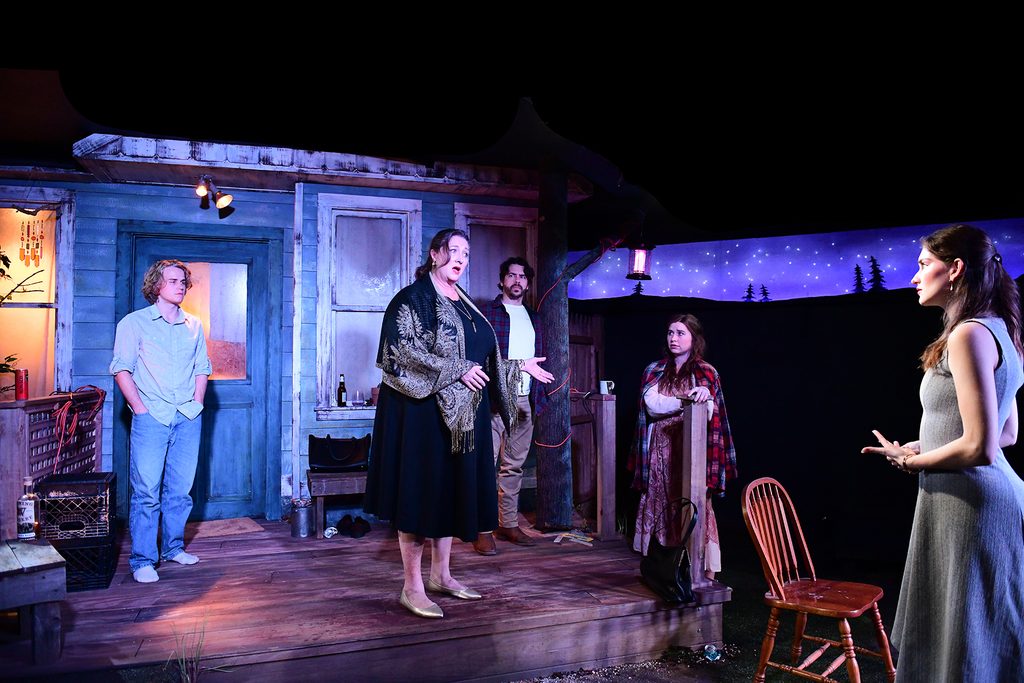
If you possess progressive values, Heroes of the Fourth Turning might help you understand the conservative mind. If you are a conservative, this play might break your heart. Or it could go completely the other way. Wherever you find yourself when the lights go down, you are likely to emerge with a better understanding of the complexities of being a well-educated Catholic in our times.
Playwright Will Arbery captures the long-standing tradition of Catholicism at its most intellectual, putting a contemporary stamp on it with a quartet of people connected to a conservative Catholic college in rural Western Wyoming during Donald Trump’s first term and two days before the 2017 solar eclipse. They’ve gathered after seven years to celebrate the inauguration of a beloved professor as college president but their encounter turns into a coming-to-terms with who they have become.
Rage and despair are the organizing principles of Heroes of the Fourth Turning. Every member of this quartet, of whom three are alumni, is angry or hurt even if they may not express it in the moment. From the opening scene in which Justin, on whose ramshackle property the play takes place, has a disquieting encounter with a wild animal, something troubling is in the atmosphere. Nate Santana plays this older former vet who’s chosen a rural life with a believable mix of calm and compassion that covers a bubbling sense of sadness. He connects easily with the play’s most empathic character Emily, who suffers from a disease that has compromised her immune system. She is the daughter of the president née professor. Magdalena Dalzell beautifully conveys Emily’s heart and how it sets her apart from the others. The Brilliant Redhead, who accompanied me, noted that Emily is the most honest of the four about the failures of Catholicism, a humaneness linked to the time she spent at an urban organization that served pregnant Catholic women in poverty and distress. Her opposite is Teresa, ideally played a with a biting, sharp confidence by Isa Grofsorean whose heartless viciousness shows her a very different world. She is a blogger and influencer, an Ann Coulter clone with an education that allows her to quote Hannah Arendt and analytical skills that help her footnote the bile she spews. Then there is Kevin, the most visibly lost. Beck Nolan embodies this tortured young man, who works for a Catholic publishing company and lives a life that, by his own telling, veers between masturbation and tears. The Brilliant Redhead observed that he is the one who conveys the side of Catholicism that is filled with shame while Emily’s experience alludes to the religion’s efforts to control sexuality, particularly female sexuality.
Into the drunken intellectual debates of these four marches Gina, the newly minted president, with all the wisdom of age and experience. Kirsten Fitzgerald, Red Orchid’s artistic director and a longtime ensemble member, brings her always stunning dramatic skills to Gina, portraying her as tough yet understanding, a resolute woman with a good grasp of the many changes in the political landscape of her lifetime. She commands the space as she offers the older voice of conservatism with some surprising views and more subtle interpretations of events and people that can come with age.
One of the strengths of Heroes of the Fourth Turning is its refusal to turn these characters into easy stereotypes – the attack dog, the rugged country man, the volunteer Christian type. Arbery’s background may have helped with this. He grew up in a similar small town where his parents are professors at Wyoming Catholic College. But this is such an idea-heavy play, especially since it runs two hours with no intermission, that it requires actors of the caliber of this corps and a director as proficient as dado to keep it moving. The production team also needs to be top-notch. Grant Sabin’s set with a weary house, dusty yard and view of the mountains and Eel Black’s props summon a rural remoteness. Madeleine Shows’ costumes range from Emily’s flowers-and-lace country-hippie dress to Teresa’s chic, hard-angled grey dress, capturing each character’s essence. This play demands a lot fromaudiences. At our performance one woman was on the edge of her seat, beaming as she watched the engagement, taken in by every syllable. A few seats away another woman was snoozing.
The complexity that Heroes of the Fourth Turning offers is timely in this second term of Trump and compassionate Catholicism practiced by Pope Leo and his predecessor Pope Francis. Such complexity is an alternative to our human tendency to group all conservatives in one political pool. Arbery even explores insider views of Trump, whom one political expert I know called the pit bull for Republicans, a man who did and said what many of them wanted and felt but couldn’t express publicly because those views were so vicious and cost votes. Here you have nuance, most welcome in this time in which we need to repair our broken people and political systems. If you are willing to have your eyes opened to other perspectives, this is your play.
Mexodus
The Studebaker Theater through November 29
Highly Recommended
From the minute Brian Quijada was born, a dramatic exit from the maternal womb that kicked off his ingenious 2016 Where Did We Sit on the Bus, I’ve been a fan. In that funny, searing solo memoir with music and sound effects, Quijada’s only tools were his impressive wit and presence, used as a scalpel to reveal the omission of Latine from the his third-grade lesson on the Civil Rights Movement.
Quijada brings the same talents and tools to his new show, a hip-hop musical that also explores absences. Mexodus tells a story long kept underground about how thousands of enslaved Blacks escaped to freedom in Mexico on the little-known southern branch of the Underground Railroad. This is not a solo show or a solo effort. Quijada again collaborates with Chicago’s Teatro Vista Productions, which was involved in the world premiere of Where Did We Sit on the Bus? His other collaboration is essential to the success of Mexodus and that is his co-creator Nygel D. Robinson who, like Quijada, is a man of multiple talents. Together they layer this story of one runaway slave who found freedom in Mexico using a range of instruments and singing styles, joined by live-looping and a lot of movement. Quijada plays Carlos, a farmer on a small farm, as a cautious but compassionate man dealing with personal shame. He rescues Henry, a slave on the run after killing – in self-defense – his owner. Both men are compelling as they develop a bond but Robinson is magnetic, bringing depth and humanity to his Henry.
Aside from Teatro Vista, the award-winning, critically acclaimed Mexodus has deep Chicago roots. Quijada grew up in the Northern suburbs Glenview and Highwood. Robinson used to live in Chicago. Early on Mexodus was workshopped at Victory Gardens Theater. And then there is the House Music, a genre developed in Chicago.
The show’s creative team is of the same caliber as its co-stars. Director David Mendizábal keeps the pace perfect whether in the slower or energized portions. His costumes are an extension of his understanding of his actors. Tony Thomas’ choreography is praiseworthy for its kinetic expertise. Riw Rakkulchon’s multi-story set, filled with the trappings of a Mexican farm and the more modern equipment such a show audio requires, is exactly right. Kudos to Mikhail Fiksel for his sound design, including looping systems, and to Johnny Morenofor his video work.
In its New York off-Broadway run, Mexodus won prestigious awards and earned critics’ praise. The friend who accompanied me also loved its energy, acting, musicianship and its bow to her brand of House Music that took her back to the pre-gentrified Bucktown of her youth. The more didactic parts of Mexodus fed my unending concerns about secondary and higher education. I was marveling about the unforgivable omissions from the history we teach and wondering if it was not briefly covered in the good old DEI days. Alas the battle over curricula at the secondary and higher education levels is a long one with many ugly chapters. It will outlive us all. At the moment the sad truth is that too often the warring factions leave us with either a bland white-bread take on history or a more progressive but hyper-corrective Kumbaya take. Some of it is well meaning; some not. Little does what it should – present varied viewpoints and arm children with the critical skills, skepticism and ability to figure it out. I still remember when our youngest child came home from pre-K with a beautiful hat. I asked its origin and was told that a parent came in to tell them about Africa and taught them how to speak African. I had to break my pre-K child’s heart by saying there was no such language as “African.” For these reasons, and for the entertainment it provides, I am grateful for Mexodus and urge you to experience it before it closes this Saturday.
The Royale
Writers Theatre through November 29
Highly Recommended
From the irresistible opening clap, hand to hand, then hand to body, that heralds the first fight of the night, it’s clear the blows will not cease. Meet Jay, a boxer of burning ambition. His is a fire that will burn many.
The year is 1905. Jay Jackson is already the “Negro Heavyweight Champion” but that’s not enough. He wants to be THE Heavyweight Champion but he keeps crashing into Jim Crow. Playwright Marco Ramirez was inspired by Jack Johnson, “the “Galveston Giant” whose 1910 fight against the world heavyweight champion, who happened to be white, was called “the fight of the century.” Its outcome led to race riots across the country. In a lean 90 minutes, punctuated by clapping and commentary, Jackson pursues this dream with the help of his trainer and sparring partner, both Black, and his white manager. Ramirez’ decision to keep the focus on Jackson and those close to him lends more intensity to the training and fight than real fight scenes in other dramas about boxers and keeps the spotlight on the uneasy balance of the personal and the political. His script, in the able hands of Director Tyrone Phillips, raises all sorts of questions. Where does personal ambition fit in the world of racism? If you are a race warrior, are you about your community or yourself?
The Royale, a title with its own story, opens with a white man introducing two boxers who stand side by side, facing forward, not looking at each other. One is Jay “The Sport” Jackson; the other Purley “Fresh Fish” Hawkins. Jackson is in his prime. Hawkins is an amateur boxer in his first professional fight. Not surprisingly Jackson wins but he is impressed by this young Southerner who goes by “Fish” and makes him his sparring partner. They become close as they prepare for the big fight. The senior roles are occupied by Jackson’s trainer, who provides the calm and his backstory here, and his manager, who navigates the white world to which he has an automatic passport. Jackson is the present; Wynton, his trainer, the past; Fish the future. Manager Max is the business realist. When Jackson’s sister arrives, she becomes the voice of political reality. Everyone in The Royale understands the stakes and experiences hesitation and fear.
To pull all this off takes a superior cast and this one is. La’Tevin Alexander’s Jackson is a man of many sides, confident, angry, vengeful, proud. Alexander excels at showing how much Jackson understands – and wants with his examination of his character’s choice, a dangerous mix of political ambition and the need to avenge wrongs. In the press conference before the big fight, a reporter asks if Jackson has any worries about his personal safety. “You see – That’s one thing I’ve learned about boxing,” he replies and pauses. “At the end of the day, the person most likely to take you down (another pause) [a]in’t even in the ring.”
Ajax Dontavius portrays Fish as a sweet young man with impressive psychological insight for his age. He captures Fish’s growing admiration of and affection for Jackson. James Vincent Meredith, always excellent, is Wynton, the loyal trainer who keeps Jackson focused. Meredith is especially moving in telling the story of his fighting days, another ugly example of racism. Scott Aiello, a welcome regular in Chicago theater, is Max, Jackson’s manager, who is torn between his loyalty to Jackson, his desire to do good business and his understanding of the racial realities of the time. AnJi White as Nina, Jackson’s sister, is the gamechanger. I still remember White’s brilliant turn just over a decade ago in Dominique Morrisseau’s searing Sunset Baby at TimeLine Theatre. She brings the same intensity here as the realist, fearful for her family, her brother, her race if he wins this fight. Each of these characters offers insight and unravels the motivations of Jay Jackson. What drives him? Is it just personal ambition or the desire to change racial history? Should the two be separated? The tricky piece always is the choices we make.
The technical choices made by the creative team, some at the expressed direction of the playwright, are beyond dispute. Lauren M. Nichols’ stark set, dominated by the heavy boxing bag often at its center, summons the grit of a boxing ring, whether for practice or performance. Jason Lynch’s lighting enhances it. Gregory Graham’s costumes fit their wearers whether they are boxing shorts, suits or dresses. Rasell Holt’s choreography creates a sense of a fight while honoring the playwright’ desire for a different approach.
In some sense The Royale raises more questions than it answers but that is part of its appeal. Another draw is the examination of how the suppression of the sentiments accompanying racism sometimes manifest as rage, shame and/or humiliation but usually percolate before finding public expression. Understanding this seems critical in our current moment. The Royale offers a taut and illustrative telling of the consequences implicit in a racially charged boxing match, a fallout still far too familiar in our time and therefore well worth seeing.
Adirondack Chair Circle
Steppenwolf Theatre Company through December 13
Recommended
The crow steals this show. No doubt about it. He is the shiny object, the winged observer, the moral commentator and a highly entertaining presence in a quartet of suburban women who range from bullying blue jays to chattering parrots to relentless woodpeckers to doves with attitude.
Adirondack Chair Circle is a satire about three right-wing suburban women campaigning to ban what they consider inappropriate books – read as ones about sex, sexual preferences and identities – from their local school library and a progressive woman with a different perspective. The sad news – such a descriptor seems appropriate in light of the contemporary newsworthiness of the subject – is that this continues to be a relevant issue. The bad news is that these characters don’t really rise above stereotypes and caricatures but, then again, this is a satire where such limitations are permissible. So where does that leave an audience? The local news is that it’s written by the peripatetic Playwright Stephanie Alison Walker, a “native Chicagoburbian” who knows her home turf. The entertainment news is that there’s pickleball. The good news is that Adirondack Chair Circle offers succor to patrons exhausted by the battles playing out in our country, a chance to laugh at matters that are far more serious in real life. Call it a comic version of preaching to the choir and let’s face it: The choir can get weary, no longer able to harmonize or hit those high notes, so a little positive preaching can be welcome and refreshing. Nota bene that the Brilliant Redhead and I attended Adirondack Chair Circle’s opening, which was three days before the “Blue Surge” that changed our current political state. Our audience loved the play but others may now see it differently.
Either way, this show is fun, and that counts for a lot these days, plus the acting is of Steppenwolf caliber. There is a tragic element in the unhappy story of one mother’s fight to stay in the life of her trans child even though that choice runs contrary to her ideals. Ironically the male roles in Adirondack Chair Circle are more compelling than the female ones. Crow, although a bird, is not one-dimensional. Even the Proud Boys trainer, although a predictable type, is wonderful to watch and does embrace the Feminist view that women apologize too much amid all his macho strutting. There’s also an eye-opening examination of power and what it means in gender terms and in a larger sense. Perhaps most important, the Brilliant Redhead, who grew up in a small Illinois town as the daughter of educators, thought the suburban women “really nailed” the nastiness of small-town gossip and in-fighting. That should make any urbanite pause to wonder about the differences between small-towns and suburban communities.
Whatever they decide, they definitely want to enlist Crow. David Darrow, a year after his magical turn as Wolfgang Amadeus Mozart in Steppenwolf’s splendid Amadeus, is perfect here as well. He’s traded the pop-your-eyes-out jackets and wigs he donned in Amadeus for tasteful black but kept the same kinetic energy and magnetic delivery that propelled his Mozart. One minute Darrow is rattling off facts about crows with erudition; the next dishing on the suburban witches on whom he eavesdrops; the next eliciting uncontrolled laughter as he navigates steps with the hoppy caution of a bird with limited flexibility in such matters. He is one perspicacious bird and his revenge is beyond amusing. Darrow brings all the right growl and machismo to his turn as the Proud Boys trainer who helps this flock understand power.
Katrina Lenk, a well-awarded Broadway actor, is the leader of this pack of suburban wives. She bestows on Banna, the mother of the trans teenager, a calm interpersonal diplomacy that makes clear why she’s running this effort but also convincingly captures the heartbreak of losing the love of a child. Sadieh Rifai, always excellent on Chicago stages, is a whirl of rage and profanity as Libby, the merciless and unzipped member of this tribe. Wendy Mateo nicely plays Winona, the softest member of the Right-wing trio, as a susceptible woman given to accidental indiscretion and not quite in lockstep with the other two. And then there is the outlier in this conservative world. Steppenwolf Ensemble Member Caroline Neff, an actress who excels in a wide range of roles, here is Evelyn Grace, beloved by Crow, a pickleball star and a woman of progressive politics and reason.
It’s quite the cocktail of characters, kept at a high pitch by the deft direction of Pam MacKinnon, whose critically acclaimed 2010 Who’s Afraid of Virgina Woolf? starring Ensemble Members Tracy Letts and Amy Morton offered a stunning new read of a searing classic. Todd Rosenthal’s ingenious set morphs from the chair circle of the title focused on a fire pit to a pickleball court with ease. Izumi Inaba’s costumes are delicious and ooze casual suburban wealth.
It’s worth noting that Adirondack Chair Circle is a contemporary nod to German Artist Bertolt Brecht’s The Caucasian Chalk Circle, a parable about war, class and parenting written in 1944 while Brecht was a refugee in America and before he was investigated and cleared by the House Committee on Un-American Activities. Brecht is always timely but seems more relevant these days. In the world of satire, Adirondack Chair Circle is welcome too. Call it a rescue, a humorous balm for the weary. Whatever it’s called, don’t miss that crow.
The Winter’s Tale
Chicago Shakespeare Theater through 12-13
Highly Recommended
This Winter’s Tale belongs to the women. True it is the story of a king seized by unjustified jealousy and finally brought to his senses by a woman but in the version now onstage at Chicago Shakes the women rule in a way that would have pleased the Bard, who was quite expert at creating brilliant and moral females.
The start is dreamy and a bit magical with a stage devoid of people. It is nighttime and a child’s bed, a teddy bear, a ship and an hourglass – precursors of what’s to come – are center stage. The young prince of Sicilia appears, embraces his teddy bear, sails his boat through the air and turns over the hourglass, no doubt a reference to the 16 years that will pass in The Winter’s Tale. We are transported to a high-spirited party in the court of his father, King Leontes, who is hosting his dearest friend, King Polixenes of Bohemia. He presses the latter to extend his visit but Polixenes demurs until Leontes entreats his queen to intervene. When his friend agrees, Leontes tumbles into irrational jealousy fueled by the belief that they are lovers and his wife is pregnant with Polixenes’ child rather than his own. No one believes this but neither his adoring wife nor his dear friend nor any of his noblemen can persuade him otherwise. The queen is imprisoned and gives birth to a daughter, who Leontes orders taken to the woods and abandoned. That leads to the most famous stage direction in Shakespeare: “Exit, pursued by a bear,” and the bear here is terrifying rather than humorous. Queen Hermione endures a trial at which her husband rejects the Oracle at Delphos’ proclamation of her innocence, and then faints at the news that her son with Leontes has died, weakened by the horrible accusations against his mother. The next news about Hermione is the announcement of her death, which causes Leontes to finally be filled with regret and remorse.
The second half of this Winter’s Tale finds us in sunny Bohemia where a dim-witted shepherd’s son happens on the abandoned princess and, with the help of his guileless father, rears her. Jump ahead 16 years and find a beautiful princess, who does not know she is of royal blood, living happily with the shepherds and being courted by the son of King Polixenes. Small world indeed even in ancient times. Now starts the descent into silliness and a delightful descent it is complete with con men and slow shepherds. Not that life in the Sicilian court has disappeared. Scenes with Leontes and Paulina, the Sicilian noblewoman who has become his moral guide in his repentance, and happens to be the widow of the nobleman who lost his life to that bear, punctuate these acts. Usually, by the end, it’s all wrapped in a lovely bow of happiness and forgiveness.
The Winter’s Tale has always been one of William Shakespeare’s trickier plays in part because it is two plays. This is true of other Shakespeare “problem plays” that veer from tragedy to comedy to romance but often they flow between genres. Here it’s much tougher. These tragedies are epic and the comedy isn’t just for relief, a quality that appealed to original Elizabethan audiences far more diverse than ours and used to longer plays. Rather it dominates the second act. The Winter’s Tale even defies the established classifications of comedy, tragedy and history bestowed on Shakespeare’s onstage oeuvre. One ought not rewrite Shakespeare but good directors regularly rethink it and that is what CST Artistic Director Edward Hall has done here. There is much to admire in his vision and decision to eschew trying to connect the two stories and letting each be itself. No spoiler here but his directorial choice about how the play ends is refreshingly radical and decidedly Feminist.
Of the 14 cast members, 12 are talented CST regulars who make this work in part because of their ability to convey the deep emotional state of those they portray. The leader of the royal pack is Demetrios Troy, who demonstrates the agonies of King Leontes’ jealous rage and eventual repentance in a new and revealing way. It’s hard to make such an unreasonable man sympathetic but Troy’s ability to step into a spotlight and show the king’s thoughts with his face and body adds dimension to an otherwise incomprehensible man. His noblemen – especially Ronald L. Conner, Sean Fortunato, Kevin Gudhal and Erik Hellman – normally somber sorts, here display their horror at the sudden change in their monarch. Hellman, who follows King Polixenes to Bohemia when his life is in danger, gives breadth and humor to his time in exile. Issy van Randwyck is unparalleled as a fierce Paulina, who seems to be channeling the power of all women trying to get through to clueless men as she repeatedly stands up to them. Shakespeare gives Paulina great words but van Randwyck uses intonation and every muscle to turn them into power and take over each space she enters. Everyone is terrified of her as she orchestrates many of the essential actions and major psychological changes in the play despite being widowed, a state caused by her King. Whenever van Randwyck appears she is the star in this constellation.
I am a longtime observer and fan of colorblind casting. My coverage began in the 1980s reporting for National Public Radio on Goodman Theatre’s decision to cast its first Black child as Tiny Tim in its annual crowd-pleaser A Christmas Carol. In this Winter’s Tale, the Black actors add dimensions that keep Shakespeare current and enhance the play. Blackness comes in many forms, as it should and does in life. There is the stately but warm grace of Queen Hermione, perfectly portrayed by Jessica Dean Turner, a beauty who radiates poise, love and kindness. There is the whimsy of Felicia Oduh as her young son Prince Mamillius, and later as her daughter, pretty Princess Perdita. Hall’s decision to have one actor play both children serves as a lovely means of expressing royal legacy from one child to the next. There is Chiké Johnson as the tall, handsome King Polixenes of Bohemia, an able leader and a good-natured friend, capable of being ridiculous in a deliciously humorous scene and employ parental rage when required. There is Ronald L. Conner, a member of the courageous corps of noblemen but one whose contemporary yet universal gestures and sounds of disbelief make him an unforgettable part of Leonides’ court until his encounter with that bear.
After the bear comes this Winter’s Tale sunny second half, full of transformations and much mirth. The always superior Sean Fortunato is no longer a proper lord but now the rapscallion Autolycus, who hawks goods of questionable provenance. Fortunato is revered for his serious roles but he’s also a comic genius. His pickpocket scene is masterful but his musical turn brings the house down. An Alice Cooper lookalike, Fortunato clad in skin-tight black leather and a fulsome floor-length fur, is the kinetic singer for the riotously named band Sheep Trick. It’s a hard act to follow even if it is a bit over the top. Kevin Gudahl, another beloved veteran who’s appeared in or directed 65 CST productions, embraces his comedic side as the sweet shepherd who is rearing the princess with his wacky son, played with great animation by Dan Haller, one of the few actors making a CST debut.
Michael Pavelka’s sets and costumes capture both the Sicilian Court with minimal props that underscore the tragedies that unfold there and the Bohemian countryside bursting with warm color whether on the people or in the foliage, and his shepherd and sheep get-ups are unrivaled in their hilarity. His massive wood-paneled curved backdrop with its long rectangular window offers the ideal vessel for observers to peer out and gripping videos. Lighting Designer Marcus Doshi’s subtle but strong choices add much. Composer Kieran McCabe and Sound Designer Emily Hayman complete the dramatic experience with skill.
The Winter’s Tale marks the return of more Shakespeare to Chicago Shakespeare Theater, which, in and of itself, merits celebration. There’s been much ado about the absence of Shakespeare in the last several seasons in lieu of unShakesperian shows. To be fair, not all of the Bard’s plays are of the same quality, and a lot of folks aren’t willing to see the great ones again and again. Happily, we have this elegant and amusing version of, if you will, a tale of two cultures. Even better, The Winter’s Tale is running in repertory with A Midsummer Night’s Dream so the same actors will soon be onstage in entirely different roles as they move between the plays. I can’t wait to see what silliness unfolds therein, especially in the play within the play, which always makes me laugh. My advice: See The Winter’s Tale for its women and multiple but engaging personalities. Then let it warm your heart and tickle your funny bone.
Musical Homage


Remembering Tom Lehrer
I was about 11 when Tom Lehrer jumped into my consciousness and stole my intellectual heart.
I’ll blame it on my parents who were crazy about this genius mathematician-turned-showman, the author of some of the wittiest satirical songs most of us had ever encountered. We spent many a night after family dinner wearing out the vinyl on Lehrer’s That Was the Year that Was. By the time I was12 I knew all the lyrics on that album, and a couple other well-worn records by Tom Lehrer. For true Lehrer devotees, picking a favorite song is impossible but singing as many as possible as often as possible is impossible to resist – much to the annoyance of non-Lehrer fans or other sorts of American Puritans he would most certainly eschew. Fortunately, my parents were far from that, and I had the good luck to marry a man who happily sang Lehrer along with me, though he was usually in key. So Lehrer’s late July death at 97 hit me with enough of a smack that it’s taken me a while to collect my thoughts, and to trace his impact on my life.
In my junior year of high school, my mother was offered a visiting professorship at Harvard Law School, an opportunity she happily accepted for many reasons, not least among them that she’d not been able to accept the full scholarship Radcliffe offered her because her parents couldn’t afford to send her across the country for college. Already a surly teenager, I was eager to escape the irritating pretensions of the University of Chicago, where the administration often made racist and other horrible decisions that eclipsed the good work and politics of my parents and their friends and colleagues. My parents took the view that while the Hyde Park neighborhood had some merits and lots of smart and wonderful people, it also possessed a cloyingly small-town nature that required true city folks like us to leave it often to explore the delights of Chicago, and to find decent restaurants. Given this, my adolescent spirit was prepared to dive into in the cosmopolitan charms of Cambridge and Boston. That disappeared as soon as I discovered that pretense and academic pedigrees were an art form at Harvard compared to the rumpled, multisyllabic, grumpy nature of your average U of C habitué or Hyde Parker.
The fact that I was sent to a “school for young ladies” in a Cambridge house did not improve my teenage outlook. However, one fact, and that school’s proximity to it, elated me. Tom Lehrer taught at Harvard and lived nearby. Call me naïve but, at 15, I thought the best way to meet him was to go to his house every day after school and sit on his steps in the hopes that he would emerge or come home after work whereupon I would express my admiration of his brilliant lyrics and fawn all over him. Weeks went by. This did not happen. Finally, one cold afternoon, the door opened and my heart leapt. A woman peered out and asked me why I was sitting on her porch every day. I explained that I wanted to meet Lehrer and asked if this wasn’t his house. Yes, she replied, but he had the good sense to go to Santa Cruz that winter and she was renting his house. Crestfallen, I went home and consoled myself with art. At that time, I intended to be a dancer and choreographer so I persuaded one of my two school friends, both also outliers, to join me in creating a dance to Lehrer’s “The Vatican Rag.” Her Czech mother sewed our nuns’ habits from old pillowcases, and we used Mardi Gras beads that doubled as belts we could swing around and as rosaries.
We started performing our “Vatican Rag” around Cambridge. People seemed to like it, except for one woman who found it scandalous and turned to express her view to my father, who was sitting next to her. “That’s my daughter,” he said with some pride. He was a professor of humanities and religious studies among other subjects so I like to think that it was more than mere paternal pride.
The Cambridge grapevine, it turns out, was as good as the Hyde Park one. When Lehrer returned to Cambridge in the spring, word reached him that two girls were performing a dance to his “Vatican Rag” around town. Connections were made, and Lehrer came over to our house, singing and playing the piano while I performed our dance for him. His delight was contagious but not nearly as enormous as mine. My mother, herself delighted, filmed this encounter. Alas that ancient videocassette returned with me to Chicago only to become the one piece of my luggage the airlines have lost forever so all I have is the memory of that remarkable afternoon – and, of course, Lehrer’s glorious song.
I headed off to Macalester College in St. Paul, Minnesota in the Fall but was so smitten with Lehrer that I managed to stay in touch with him. He was campaigning for George McGovern by singing at fundraisers, and the Twin Cities were on his tour. I got to spend an intoxicating evening following Lehrer around and watching him work his magic on crowds. By then, he’d performed on Sesame Street, singing adorable little ditties about “silent e” and its alphabetical relatives. He tickled the Twin Cities audiences by sharing the “Adult X-rated” version of “Silent E.”
As I’ve revisited his repertoire since his death, I’ve been struck by the giddy joys Lehrer’s lyrics cause in songs like “New Math” and “The Elements,” and the relevance of his lyrics in so many songs from “Pollution” to “Who’s Next?” Consider these from “National Brotherhood Week:”
Oh the white folks hate the Black folks
And the Black folks hate the white folks
To hate all but the right folks is an old established rule
But during National Brotherhood Week
National Brotherhood Week …
It’s fun to eulogize the people you despise
As long as you don’t let them in your school
Oh the poor folks hate the rich folks
And the rich folks hate the poor folks…
Oh the Protestants hate the Catholics
And the Catholics hate the Protestants
And the Hindus hate the Muslims
And everybody hates the Jews
But during National Brotherhood Week
National Brotherhood Week
National Everyone-Smile-at-One-Another-hood Week
Be nice to people who are inferior to you
It’s only for a week so have no fear
Be grateful that it doesn’t last all year
I was moved to discover in the many odes to and obituaries to Lehrer that he decided to release the rights to all his songs, telling his fans, “So help yourselves, and don’t send me any money.” He even had a website created for people to download his songs.
No doubt that only expanded Lehrer’s following, as does his songs’ infectious singability, which has made me continue to sing Lehrer’s songs across so many decades whenever and wherever the spirit moves me, which is often. Our children grew up on Lehrer’s songs as well, and I am now introducing my grandbaby to his oeuvre. I’m sure she’ll enjoy the kiddie versions of his Sesame Street songs when she learns to read but, for now, we’re working our way through the age-appropriate highlights of his adult repertoire so she can decide what her favorite will be.